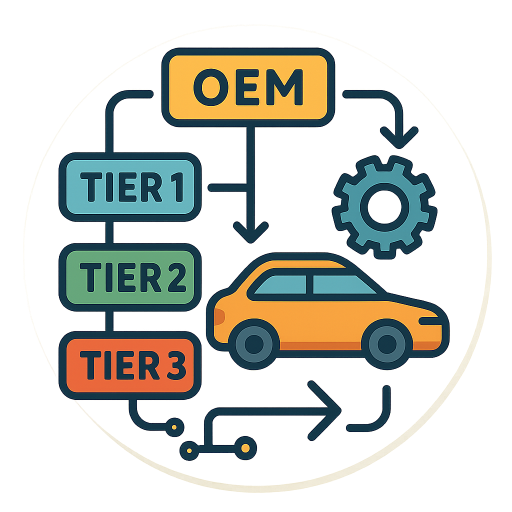
Automotive: Industry Structure and Value Chain

Description
Comprehensive understanding of the automotive industry's hierarchical structure from Original Equipment Manufacturers (OEMs) to multi-tier supplier networks, including roles, relationships, and value creation mechanisms across the entire automotive ecosystem.
Learning Objectives
Learners will be able to identify and analyze the roles and relationships of OEMs, Tier 1, Tier 2, and Tier 3 suppliers in the automotive value chain, understand the flow of components and information across different tiers, evaluate the impact of supply chain disruptions on different levels of the hierarchy, and assess how digital transformation is reshaping traditional supplier relationships and value creation mechanisms.
Topics (8)
Detailed examination of Tier 1 supplier functions including manufacturing complex automotive systems, direct collaboration with OEMs, system integration responsibilities, quality assurance, innovation and R&D partnerships, and global supply chain management.
Analysis of Tier 2 suppliers producing parts and sub-assemblies for Tier 1 companies, and Tier 3 suppliers providing raw materials, basic components, and foundational manufacturing services including steel production, semiconductor manufacturing, and component molding.
Examination of value addition mechanisms at each tier, revenue sharing models, profit margins distribution, cost structure analysis, and the impact of technology integration on value creation across the automotive ecosystem.
Comprehensive study of global automotive supply chain architecture, regional manufacturing hubs, cross-border component flows, trade agreements impact, supply chain resilience strategies, and risk management approaches.
Analysis of automotive quality standards including ISO/TS 16949, supplier qualification processes, quality audit requirements, continuous improvement expectations, and performance measurement systems across the supply chain.
Examination of how digital transformation, Industry 4.0 technologies, software-defined vehicles, and connected services are changing supplier roles, creating new technology partnerships, and establishing software companies as key suppliers.
Comprehensive overview of OEM operations including vehicle design and engineering, final assembly and integration, quality assurance, brand management, marketing and sales, regulatory compliance, and customer relationship management.
Comprehensive study of supply chain vulnerabilities, semiconductor shortage impacts, COVID-19 effects, geopolitical risks, natural disaster impacts, and industry strategies for building resilient supply chains including diversification and vertical integration approaches.